Risk-free Design
Design shouldn’t be a barrier to getting started. With Risk-free Design, we remove the up-front design fee so you can explore a credible solution before committing to builds. You get a clear, engineered path from problem to design pack – created by the same team that will take you through prototyping, manufacture and lifetime support, even including app or web design where needed – without the usual financial friction at the front end.
Summary
What “risk-free” means at TAD
We waive our design fee for the initial design phase. This covers the structured work required to turn your brief into an implementable design – so decisions are based on evidence and engineering, not wishful thinking. In practice, this could include stages such as discovery and requirements capture, concept/architecture definition, early schematics and interface direction, assembly/sub-assembly, enclosure design, a first-pass BoM strategy, and manufacturability considerations.
Third-party costs (for example, certification labs, specialist machining, external testing) may incur costs and therefore would not be included in our risk-free design service, but if they did occur, they would be quoted separately. Where a site visit is needed to understand environment and constraints, we’ll usually include an initial scoping visit as part of the risk-free service – though long-haul or unusual travel may be billable by agreement.
95% of projects meet our qualifying criteria – such as volume of manufacturable goods, market viability, or cost/price margins, as examples. However, a small number may not qualify for the risk-free design service we offer. These projects could still be viable for TAD to work on, and we would have an open discussion with the potential client at the scope stage gate to determine whether it should move forward or not.
How it works (simple stage gates)
1) Scope and acceptance
We map objectives, constraints, safety states and success criteria. The outcome is a short, shared brief with measurable hypotheses (e.g. power budget, sensing accuracy, ingress strategy) and a delivery plan. At this point, there would be a discussion around agreements and commitments, which are binding.
2) Design sprints (fee waived)
We develop the system architecture and produce a coherent design pack: functional blocks, early schematics, firmware approach, interface direction, BoM outline with approved alternates, compliance path and a risk log. The aim is clarity – not a vanity document.
3) Review and next step
We walk you through options, trade-offs and a clear route into builds (prototype > pilot > production) with schedules and costs. Risk-free Design ends here; builds, materials and external services are costed transparently. Once both sides are happy with the design stage, we move on to the outlined prototyping phase, then to manufacturing, and eventually to product launch. When you proceed with TAD, momentum is preserved – same team, same context.

Boundaries and fairness
- Major scope changes
Amendments are certainly possible, and if not major, would not trigger a change in cost. However, if direction changes materially due to new, customer-led requirements after the scope stage gate, the work typically exits the risk-free model and is re-quoted. If changes arise from discoveries within the agreed scope, we’ll propose the lightest path to keep moving. - Third-party costs
Certification, lab time, specialist machining and bought-in services are out of scope for Risk-free Design and are itemised when needed. - Qualification
Risk-free Design is intended for projects that are serious about manufacturing. This will be checked during initial discussions at the scope stage, as there would be discussions around volume, cost, viability, etc.
IP, confidentiality and ownership
We work under a standard NDA as default. For all risk-free qualifying projects, IP would normally rest with TAD, but exclusivity can be negotiated for original designs/concepts.
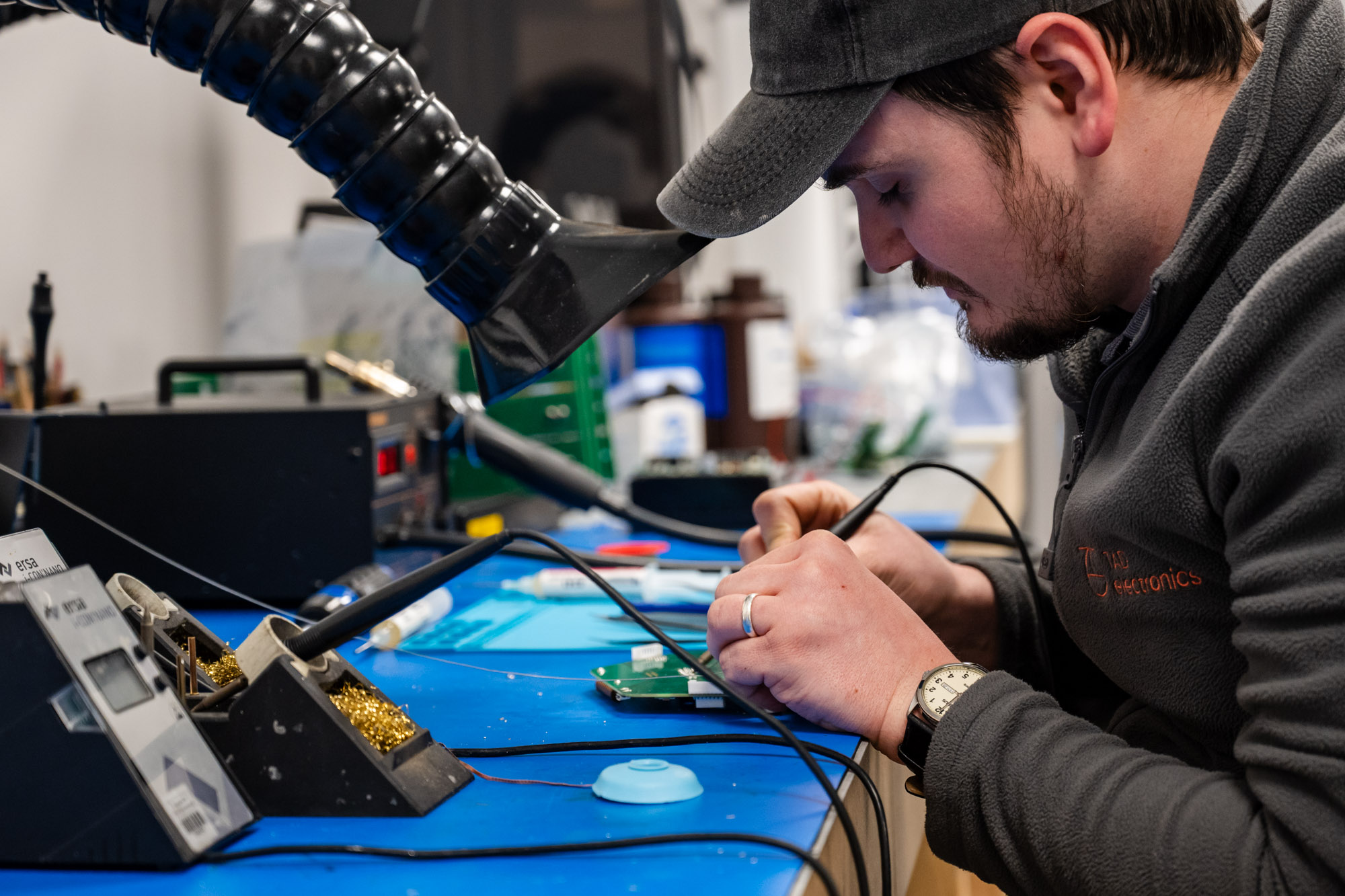
When you proceed into manufacture with TAD, everything developed during design carries directly into production. There is no handover friction – everything proceeds in-house. From initial discussions, to design, to prototyping, manufacturing, and lifetime support of the product. We even have app and website design capabilities in-house if needed.
Where Risk-free Design fits (and doesn’t)
- Great fit: New product development where you need an engineered route to prototype; upgrades that replace obsolete electronics; control/telemetry platforms that must balance safety, power and connectivity; programmes that value lifecycle thinking (BoM alternates, compliance path, serviceability).
- Less suitable: Project rescues and partial handovers typically sit with TAD Recovery (stalled or externally developed designs often require forensic review and re-work that falls outside risk-free scope).
- TAD Labs: If your project is backed by TAD Labs investment support, Risk-free Design is already baked in; commercial structures differ by agreement.
Case Studies
What you receive at the end of Risk-free Design
A concise design pack that de-risks the next decision: architecture and interface definitions, early schematics, firmware approach, BoM outline with alternates, compliance path and a prioritised risk register – plus a costed plan into prototyping/pilot manufacture. It’s enough to act confidently without being over-engineered.
Why we do it
We believe the right place to invest together is up front – to remove friction for procurement and to prove fit before anyone pays for metal, boards or lab time. It aligns incentives: we earn the right to manufacture by demonstrating design quality and practical thinking; you keep control, transparency and pace. And finally, we want to encourage people to start new projects, to innovate, and to take that brave first step – not act as a barrier to entry with exorbitant design costs like competitors.
Frequently asked
- Is anything “free” beyond design labour?
Design labour for the initial phase is waived. Materials, builds, and third-party services are quoted. - Can we still make a site visit early?
Yes – where needed and practical, it’s included at scoping; unusual travel is agreed case-by-case. - What if we pivot mid-stream?
Material, client-driven pivots usually exit the model and are re-quoted; discovery-driven adjustments are handled pragmatically. - Do you guarantee performance?
We set clear engineering hypotheses during scoping and test plans to support decisions. Backed by decades of electrical and mechanical engineering knowledge, we are confident in supplying an optimal-performing solution.
Next steps
If you’d like to explore your project with no up-front design fee, we’ll start with a short scoping session to frame the problem, success criteria and delivery plan. You’ll leave with a realistic route to prototype and production – and no surprises.
Get in touch to start your next risk-free project!